When a founder asks ChatGPT "what's the best project management tool for a 20-person startup," only 3-4 brands get mentioned. The rest are invisible.
Why SaaS Companies Need GEO
SaaS buying has fundamentally changed. Before a prospect ever visits your website, they've already asked an AI assistant to narrow their shortlist.
The typical SaaS discovery path in 2026:
- Buyer has a problem ("our content isn't showing up in AI search results")
- Buyer asks ChatGPT or Perplexity for recommendations
- AI cites 3-5 specific tools with brief descriptions
- Buyer visits 2-3 of those tools' websites
- Buyer starts a trial or books a demo
If your brand isn't in step 3, you never get to steps 4 and 5. No amount of paid advertising, SEO, or outbound sales can compensate for being invisible in the AI discovery layer.
The SaaS GEO Gap
Most SaaS companies have invested heavily in SEO over the past decade. They have strong domain authority, ranking content, and optimized landing pages. But AI visibility doesn't correlate with Google rankings.
Our research across 50 B2B SaaS brands found:
| SEO Performance | Average AI Citation Rate |
|---|---|
| Top 3 Google ranking | 23% of relevant AI queries |
| Page 1 Google ranking | 11% of relevant AI queries |
| Page 2+ Google ranking | 4% of relevant AI queries |
| No Google ranking | 2% of relevant AI queries |
Strong SEO helps — but it's not sufficient. The brands with the highest AI citation rates (40%+) have deliberately optimized their content for AI extraction, regardless of their Google ranking position.
The SaaS GEO Playbook
1. Optimize Your Product Positioning Page
Your main product page is the single most important asset for GEO. AI models need a clear, extractable description of what your product does, who it's for, and how it compares.
The GEO-ready product page includes:
- A one-sentence product definition in the first paragraph (extractable by AI)
- Specific pricing (not "contact us" — AI can't cite what it can't extract)
- Named competitor comparisons (AI models cite content that compares alternatives)
- Feature tables with specific capabilities and limits
- Customer counts or social proof with specific numbers
Example of a GEO-optimized product description: "GEOCraft is a Generative Engine Optimization platform that tracks brand citations across ChatGPT, Perplexity, and Google AI Overviews. Plans start at $49/month for 10 articles, with Pro ($119/month, 30 articles) and Growth ($299/month, 100 articles) tiers for scaling teams."
An AI model can extract this cleanly. Compare with: "We empower brands to thrive in the AI era with cutting-edge optimization technology" — which tells an AI model nothing useful.
2. Build Comparison Content
Comparison pages are citation magnets for SaaS. When a buyer asks "compare X vs Y," AI models look for structured comparison content.
Comparison content framework:
- "[Your Brand] vs [Competitor]" pages for your top 3-5 competitors
- "Best [Category] Tools for [Use Case]" articles that include your product
- Feature comparison tables with specific capabilities, not just checkmarks
- Pricing comparison with actual numbers
- Use case recommendations ("Best for teams under 50 people")
3. Make Documentation GEO-Ready
SaaS documentation is an underused GEO asset. When users ask AI "how do I set up X in [Product]," the AI looks for your docs.
GEO-optimize your docs by:
- Starting each doc page with a clear answer to the question it addresses
- Including code examples and specific configuration values
- Using descriptive headings that match how people ask questions
- Adding FAQ sections to popular doc pages
4. Publish Data-Driven Content
AI models preferentially cite content with original data. SaaS companies have a natural advantage — your product generates data that can fuel authoritative content.
Content types that drive SaaS GEO citations:
- Industry benchmark reports (using anonymized product data)
- "State of [Industry]" analyses
- Customer result summaries ("Our customers see X% improvement in Y")
- Market comparison studies
5. Maintain Freshness
AI models increasingly weigh content freshness, especially for product-related queries. A pricing page from 2024 will lose citations to a competitor's 2026 page.
Freshness cadence for SaaS GEO:
- Product pages: update quarterly with current pricing and features
- Comparison pages: update monthly (competitors change frequently)
- Blog content: publish weekly, refresh quarterly
- Documentation: update with each product release
Measuring SaaS GEO Performance
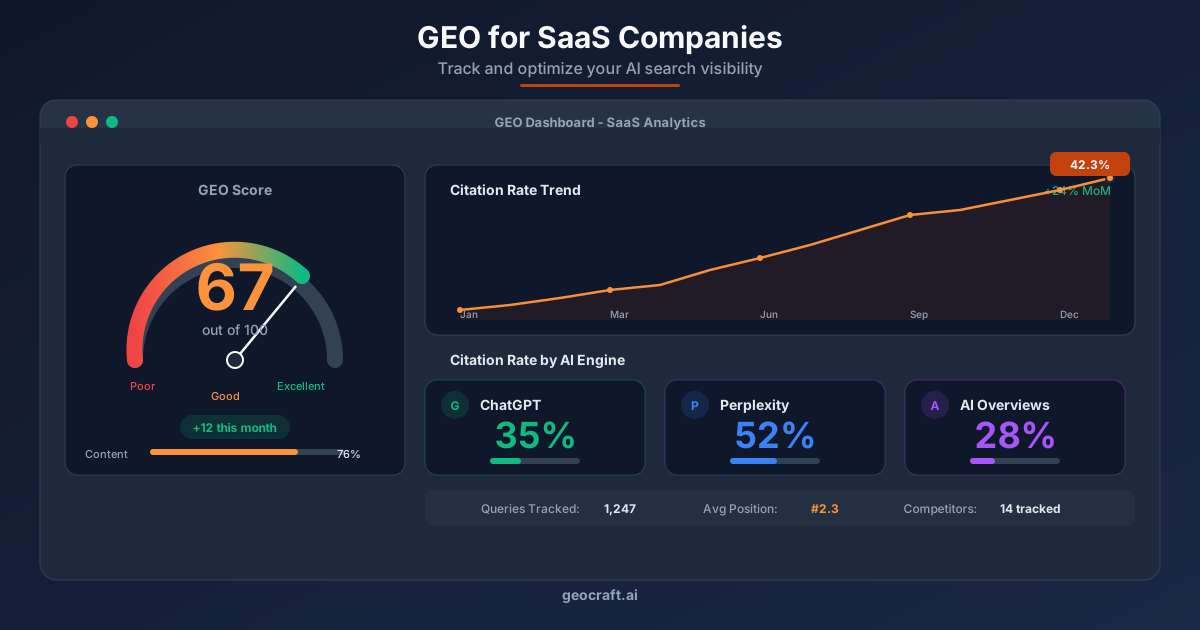
Key Metrics for SaaS
| Metric | Target | How to Track |
|---|---|---|
| Brand citation rate | 25%+ of target queries | GEOCraft automated monitoring |
| Competitor share gap | Narrowing month-over-month | Competitive benchmarking |
| Product page citations | Cited in 40%+ of product queries | Query-level tracking |
| Documentation citations | Cited in how-to queries | Doc URL monitoring |
| Trial/demo from AI referral | Growing quarter-over-quarter | UTM tracking + attribution |
Attribution: Connecting AI Citations to Pipeline
The hardest part of SaaS GEO is attribution. AI citations don't generate direct clicks — the buyer sees your brand name in an AI answer, then navigates to your site directly or via Google.
Practical attribution approaches:
- "How did you hear about us?" surveys with "AI assistant" as an option
- Branded search volume correlation — as AI citations increase, branded searches typically follow
- First-touch UTM analysis — look for patterns where first touch is direct/branded after new AI citations appear
GEOCraft for SaaS Companies
GEOCraft was built by a SaaS team, for SaaS teams. Our own company uses GEOCraft to track and improve our AI visibility — we're our own first customer and case study.
What SaaS teams use GEOCraft for:
- Tracking citation rates across ChatGPT, Perplexity, and Google AI Overviews
- Identifying competitive citation gaps in their market
- Producing GEO-optimized comparison and thought leadership content
- Measuring the impact of content changes on AI visibility
- Publishing directly to WordPress sites via the GeoCraft plugin
Start with a free GEO baseline scan to see how your SaaS brand appears in AI search today.