Your content marketing strategy is probably optimized for an engine that's losing relevance. Here's what's changed and what to do about it.
The Uncomfortable Truth About Your Content Library
You've probably published hundreds of blog posts, dozens of whitepapers, and a library of landing pages. Your SEO team has optimized them for target keywords, built backlinks, and earned strong Google rankings.
And yet, when a potential buyer asks ChatGPT to recommend a tool in your category, your brand doesn't get mentioned.
This isn't a content quality problem. It's a content structure problem. Your content was built for an era when search meant ten blue links on a results page. That era is ending.
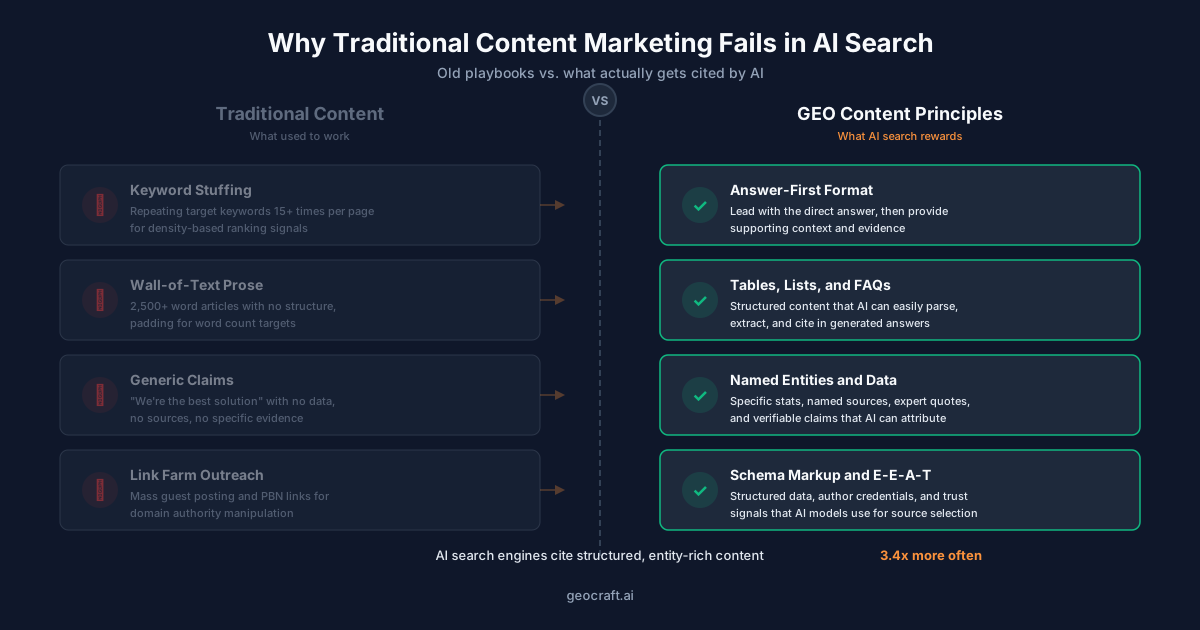
5 Reasons Traditional Content Fails in AI Search
1. Keyword-First Intros Bury the Answer
Traditional SEO content starts with context. It sets the scene, establishes the topic, and works in target keywords before getting to the substance. This is good for Google rankings — and terrible for AI citation.
AI models scan for direct answers in the first 100-200 words. If your article opens with "In today's rapidly evolving digital landscape, content marketing professionals are increasingly looking for innovative approaches to enhance their online presence..." — the AI has already moved on to a competitor's page that starts with the answer.
Traditional approach: "Content marketing has undergone significant transformation in recent years. As businesses adapt to changing consumer behaviors and new technology platforms, the strategies that once drove results are being reevaluated. In this comprehensive guide, we'll explore..."
GEO approach: "GEOCraft is a Generative Engine Optimization platform that tracks brand citations across ChatGPT, Perplexity, and Google AI Overviews, with plans starting at $49/month. It combines citation tracking, content creation, and WordPress publishing in a single workflow."
The second version is extractable. The first is not.
2. Pillar Pages Are Too Broad for Citation
The pillar-and-cluster SEO model produces comprehensive 3,000-5,000 word articles that cover a topic broadly. These rank well in Google because they signal topical authority.
But AI engines don't need a 5,000-word overview. They need a focused, specific answer to a focused, specific question. A 5,000-word page about "content marketing strategy" is harder for an AI model to extract a clean citation from than a 1,200-word article about "how much does GEO tracking cost in 2026."
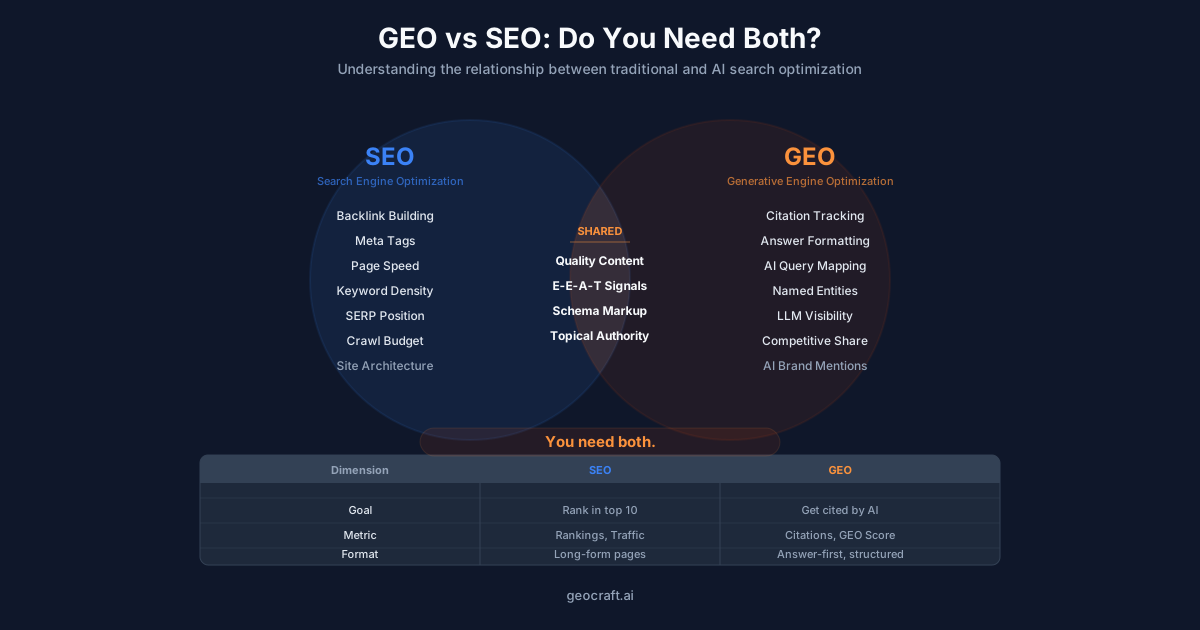
The fix: Keep your pillar content for SEO. But also publish focused, answer-first articles targeting specific AI queries. The two strategies complement each other.
3. Generic Claims Don't Get Cited
Traditional marketing content uses subjective superlatives: "industry-leading," "best-in-class," "cutting-edge," "innovative." These words are optimized for human persuasion, not AI extraction.
AI models cite specific, verifiable claims:
- ❌ "Our industry-leading platform helps brands succeed in AI search"
- ✅ "GEOCraft tracks brand citations across 5 AI engines (ChatGPT, Perplexity, Google AI Overviews, Claude, Copilot) with plans from $49/month"
The second statement gives an AI model something concrete to cite. The first gives it nothing.
4. Content Isn't Structured for Extraction
Traditional blog posts use long-form prose. AI models extract more reliably from structured formats:
- Tables are extracted at 3x the rate of equivalent information in paragraph form
- Numbered lists are extracted at 2x the rate of prose
- FAQ sections with concise answers are among the highest-extraction content types
- Comparison matrices with named entities are citation magnets
If your content library is primarily prose with occasional subheadings, it's structurally disadvantaged for AI citation regardless of the quality of the information.
5. Measurement Blind Spots
Traditional content marketing measures:
- Organic traffic
- Keyword rankings
- Backlinks acquired
- Time on page and engagement
None of these metrics tell you whether AI engines are citing your brand. A page can rank #1 on Google, get 50,000 monthly visitors, and have zero AI citations. Conversely, a page with modest traffic can be heavily cited by Perplexity and ChatGPT.
Without AI citation measurement, you're optimizing blind. Your content strategy is driving the wrong metrics.
The Structural Shift: What AI Search Demands
Answer-First Architecture
Every page needs to answer its target question in the first 2-3 sentences. This isn't incompatible with SEO — Google increasingly rewards direct answers too. But it requires rewriting your content's opening structure.
Factual Density Over Word Count
A 1,200-word article with 15 specific, extractable facts outperforms a 3,000-word article with 3 vague claims for AI citation purposes. Quality of extractable information matters more than quantity of words.
Named Entity Clarity
Your brand name, product names, pricing, and differentiators should appear in clear, attributable sentences throughout your content. AI models need to know exactly what to cite and who to attribute it to.
Structured Formatting
Tables, lists, and FAQ sections aren't just design choices — they're extraction optimization. Every key fact should be in the most extractable format possible.
Freshness Signals
AI engines are increasingly weighting content freshness. A quarterly content refresh cycle that updates data, pricing, and comparisons maintains citation relevance.
How to Adapt Without Starting Over
You don't need to throw away your existing content library. You need to augment it.
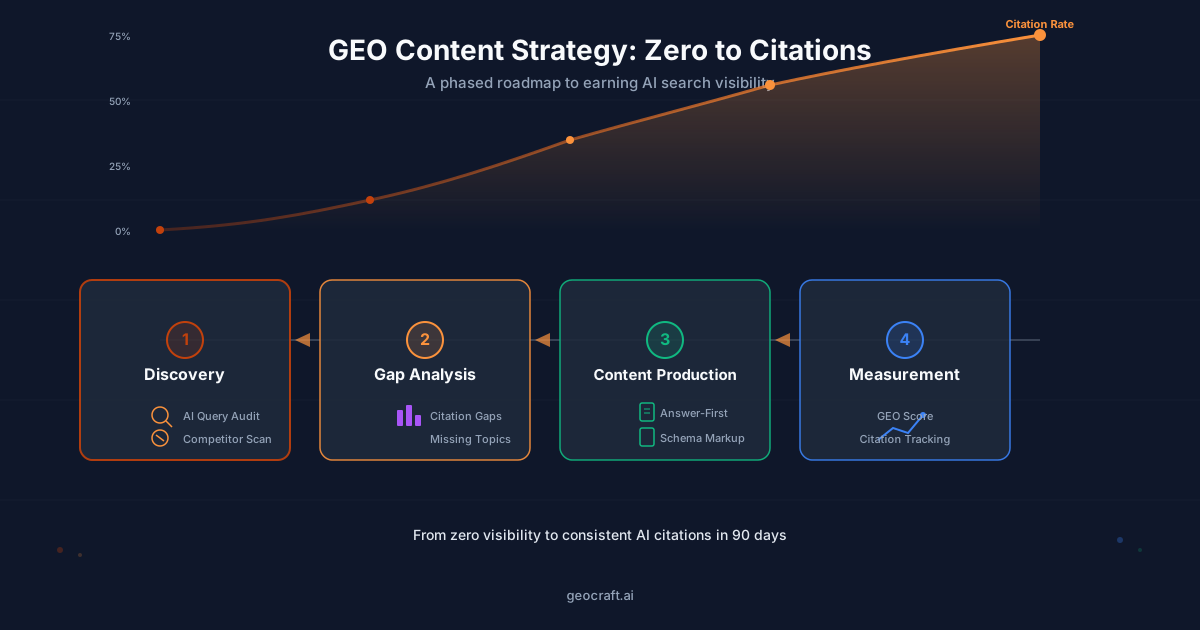
Step 1: Audit Your Top 20 Pages
Identify your highest-traffic pages and evaluate them for AI citation readiness:
- Does the page answer a specific question in the first 2-3 sentences?
- Does it contain comparison tables or structured data?
- Are there specific, extractable facts (numbers, named entities, pricing)?
- Is there a FAQ section?
Step 2: Restructure for Dual Optimization
Update your top pages to work for both Google and AI engines:
- Add answer-first openings (this actually helps SEO too)
- Convert key information into tables and lists
- Add FAQ sections with FAQPage schema
- Include specific, attributable claims
Step 3: Launch a GEO Content Track
In addition to your existing SEO content calendar, add a GEO content track:
- 3-5 focused articles per week targeting specific AI queries
- Comparison content, data-driven research, and how-to guides
- Answer-first structure with high factual density
Step 4: Measure AI Visibility
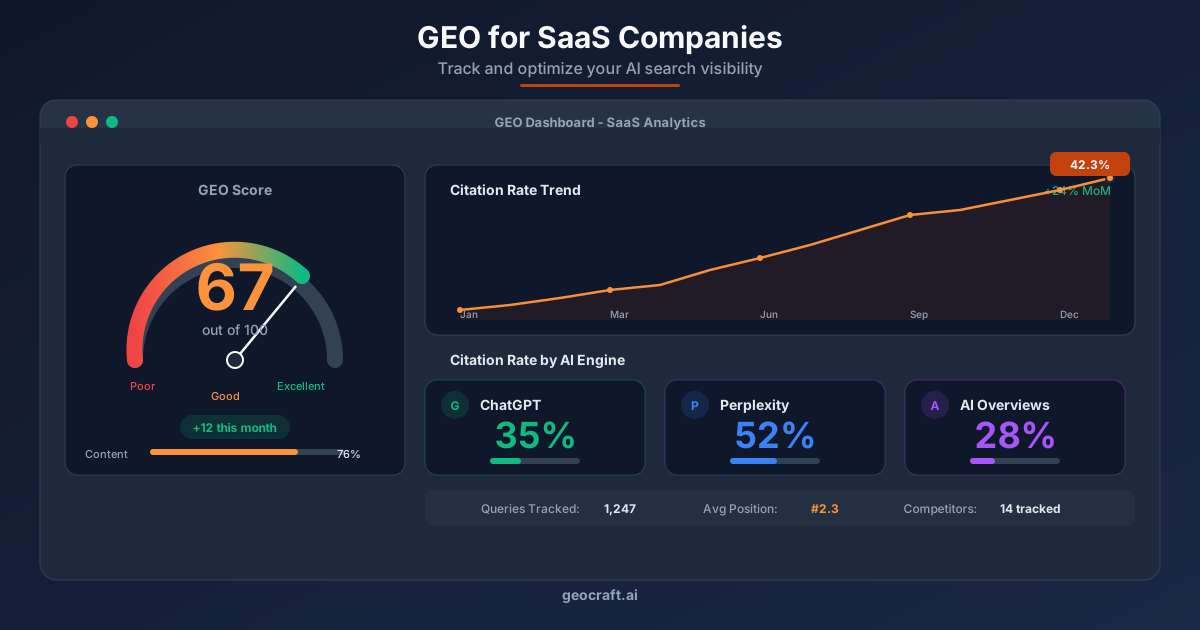
Set up tracking for your target queries across ChatGPT, Perplexity, and Google AI Overviews. GEOCraft automates this with configurable query monitoring, competitive benchmarking, and trend visualization.
The Cost of Waiting
Every week you delay GEO optimization, competitors are publishing content that gets cited in your buyers' AI queries. AI citation patterns compound — once a brand is established as a source for specific queries, it becomes the default citation that competitors must displace.
The companies that adapt their content strategy for AI search in 2026 will own the citation landscape for years. The companies that wait will face an increasingly expensive catch-up game.
Start by measuring where you stand. Get your free GEO baseline scan and see how your brand appears in AI search today.