SEO gets you a blue link. GEO gets you the answer. You need both — but they require different strategies.
The Core Difference
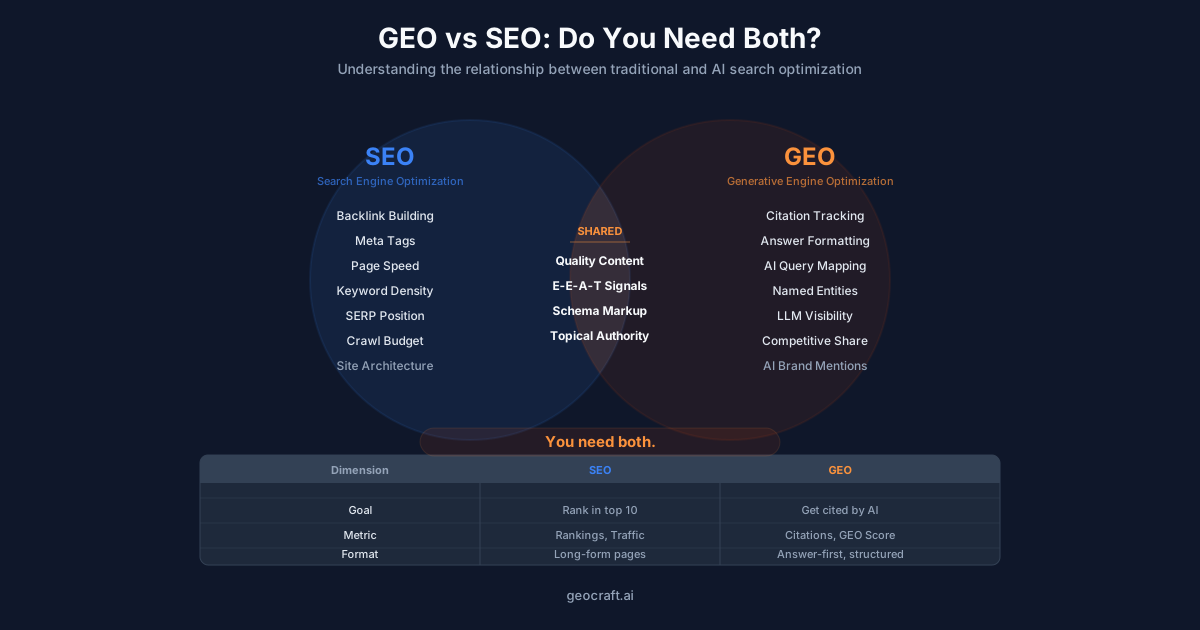
SEO and GEO address the same fundamental goal — making your brand discoverable when buyers research solutions. But they target different surfaces, use different signals, and require different content strategies.
| Dimension | SEO | GEO |
|---|---|---|
| Search surface | Google/Bing results page (blue links) | AI-generated answers (ChatGPT, Perplexity, Google AI Overviews) |
| User action | Click a link → visit your page | Read an AI answer → see your brand cited |
| Key signals | Backlinks, keyword relevance, domain authority, Core Web Vitals | Factual density, entity clarity, answer structure, freshness |
| Content style | Long-form, keyword-optimized, link-worthy | Answer-first, fact-dense, structured for extraction |
| Measurement | Rankings, impressions, CTR, organic traffic | Citation frequency, share of AI answers, GEO Score |
| Time to results | 3-6 months | 2-6 weeks |
| Competitive moat | Domain authority (years to build) | Content structure (weeks to optimize) |
The critical insight: You can rank #1 on Google and be invisible in ChatGPT. You can have zero Google traffic and be the top-cited brand in Perplexity. These are separate channels with separate optimization requirements.
Where SEO and GEO Overlap
Despite the differences, there's significant overlap:
Content Quality
Both SEO and GEO reward well-researched, authoritative content. Thin, poorly written content fails in both channels.
Domain Authority
Google AI Overviews draw heavily from authoritative domains. Strong SEO (high domain authority, quality backlinks) makes Google AI Overview optimization easier.
Technical Foundation
Both channels require a technically sound website: fast loading, mobile-friendly, properly crawlable, with structured data markup.
Freshness
Both Google's traditional algorithm and AI engines increasingly prefer recent content for product and comparison queries.
E-E-A-T Signals
Experience, Expertise, Authoritativeness, and Trustworthiness signals help in both channels — though they're weighted differently.
Where SEO and GEO Diverge
Content Structure
SEO rewards comprehensive, long-form content that keeps users engaged. GEO rewards focused, extractable content with answer-first architecture.
Practical implication: A 3,000-word SEO pillar page should be supplemented with focused 1,000-1,500 word GEO articles targeting specific queries.
Keyword Strategy
SEO targets keyword phrases and search volume. GEO targets question-format queries and conversation patterns.
SEO keyword: "GEO tracking platform" (2,400 monthly searches) GEO query: "What is the best platform for tracking how my brand appears in ChatGPT answers?"
The GEO query is more conversational and specific. Your content needs to answer it directly.
Link Building vs. Citation Building
SEO invests in earning backlinks from other websites. GEO invests in earning citations from AI models. These are fundamentally different activities:
- Backlink: Another website links to your page → improves Google ranking
- AI citation: An AI model mentions your brand in a generated answer → drives buyer awareness
You can't "build" AI citations the way you build backlinks. You earn them through content structure and factual density.
Measurement
SEO measurement tools (Google Search Console, Semrush, Ahrefs) don't track AI citations. GEO measurement requires purpose-built tools like GEOCraft that monitor AI engine responses directly.
The Business Case: Why You Need Both
SEO Still Drives Volume
Google processes 8.5 billion searches per day. Traditional search isn't going away — it's being supplemented by AI search. SEO captures the traffic from users who still use Google's blue links.
GEO Captures the Research Layer
AI-assisted research is now the first step for 73% of B2B buyers. GEO ensures your brand is present at the moment of initial consideration — before the buyer even runs a Google search.
AI Overviews Bridge Both
Google AI Overviews appear within Google Search, making the SEO-GEO distinction less clear. Content that ranks well in Google AND is structured for AI extraction gets the best of both worlds.
Compounding Returns
SEO and GEO reinforce each other:
- Strong SEO → higher domain authority → easier to get cited in Google AI Overviews
- Strong GEO → more brand awareness from AI citations → more branded searches → better SEO performance
- Content optimized for both → wider funnel, more touchpoints, higher conversion
Running SEO and GEO Without Doubling Your Budget
You don't need separate teams or separate budgets. Here's how to run both efficiently:
Strategy 1: Dual-Purpose Content
Structure every piece of content to work for both channels:
- SEO: Target a keyword, include it naturally, build internal links
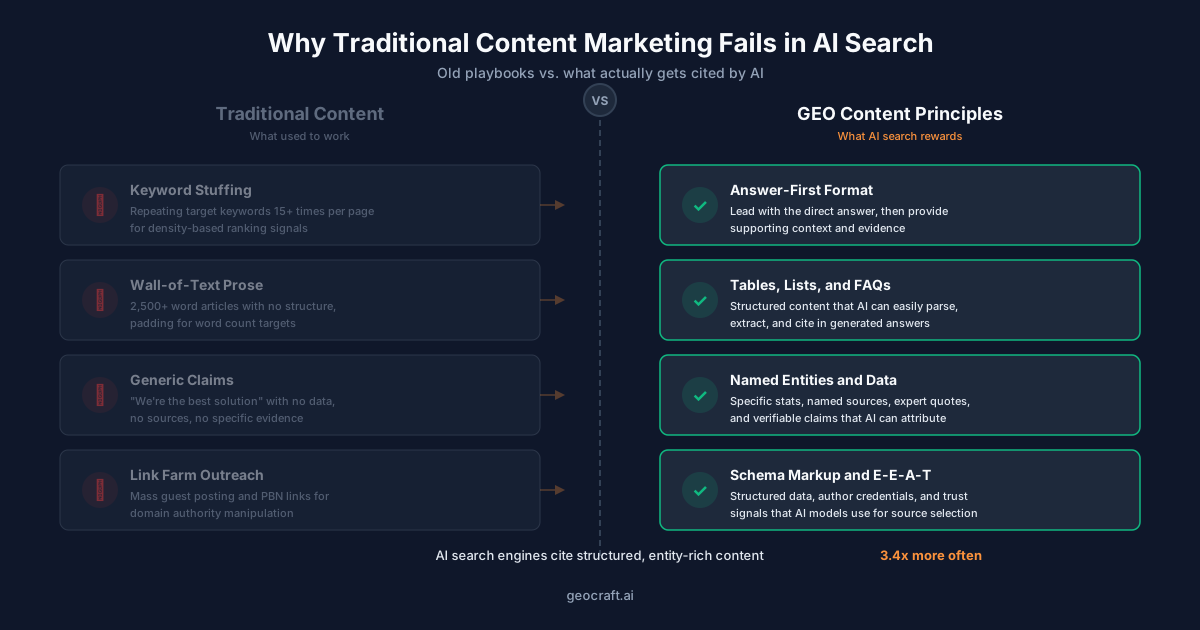
- GEO: Lead with a direct answer, include comparison tables, add FAQ section
- Both: Use specific numbers, named entities, and structured data
Strategy 2: SEO Pillar + GEO Satellite
Maintain your existing SEO pillar content strategy. Add focused GEO satellite articles that target specific AI queries and link back to the pillar.
Example:
- SEO pillar: "The Complete Guide to Content Marketing in 2026" (3,500 words)
- GEO satellite: "Best AI Content Optimization Tools for B2B" (1,200 words)
- GEO satellite: "How Much Does GEO Tracking Cost?" (1,000 words)
- GEO satellite: "GEO vs SEO: Which Should You Prioritize?" (1,200 words)
Strategy 3: Optimize Existing Content for GEO
Audit your top-performing SEO content and add GEO optimization:
- Add answer-first openings
- Convert key information into tables
- Add FAQ sections with schema markup
- Include specific pricing and feature data
This requires no new content — just structural optimization of what you already have.
Practical Priorities by Company Stage
| Stage | SEO Priority | GEO Priority | Recommended Split |
|---|---|---|---|
| Startup (0-1 year) | Moderate | High | 40/60 SEO/GEO |
| Growth (1-3 years) | High | High | 50/50 SEO/GEO |
| Scale-up (3+ years) | High | Moderate-High | 60/40 SEO/GEO |
| Enterprise | Maintain | High (catching up) | 40/60 SEO/GEO |
Why startups should lean GEO: GEO has a faster time-to-result (weeks vs. months) and a lower barrier to entry (content structure vs. domain authority). A startup with GEO-optimized content can get cited alongside enterprise competitors in AI answers before it even ranks on page 1 of Google.
Why enterprise should lean GEO: Enterprise companies already have strong SEO foundations. Their biggest growth opportunity is the AI citation layer, where many are currently invisible despite strong Google rankings.
Measuring Success Across Both Channels
| Metric | Tool | Channel |
|---|---|---|
| Organic traffic | Google Analytics / GSC | SEO |
| Keyword rankings | Semrush / Ahrefs | SEO |
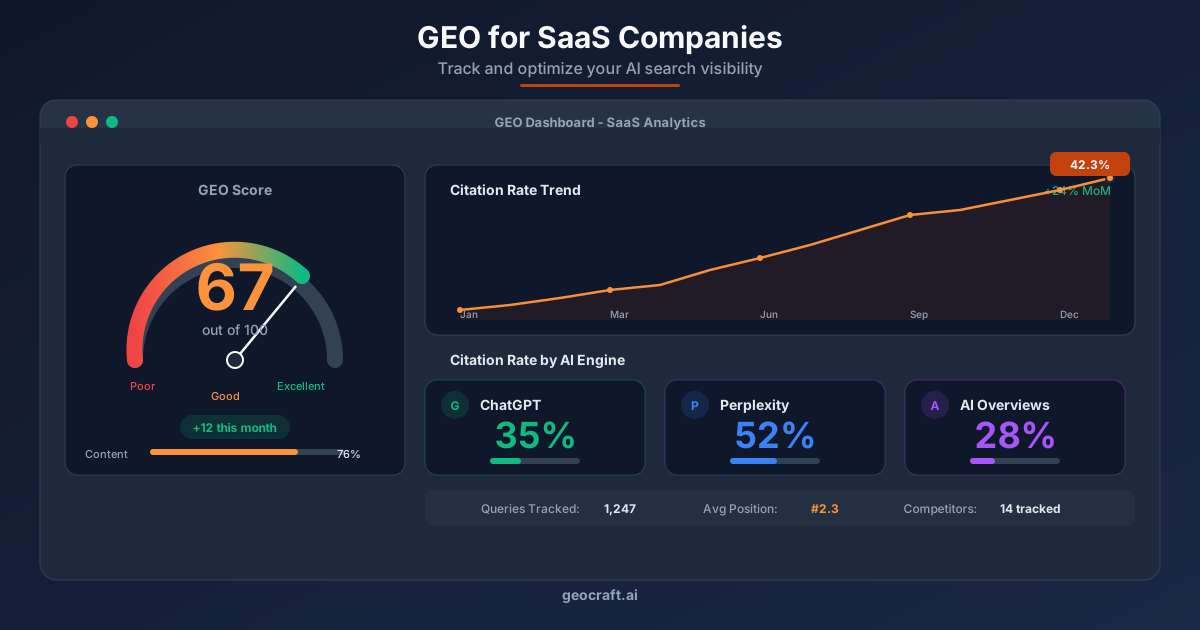
| Citation frequency | GEOCraft | GEO |
| GEO Score | GEOCraft | GEO |
| AI Overview impressions | Google Search Console | Both |
| Branded search volume | Google Trends / GSC | Both |
| Pipeline attribution | CRM + UTM | Both |
The ultimate KPI is pipeline influenced by both channels. Track branded search volume as a leading indicator — as AI citations increase, branded searches typically follow within 2-4 weeks.
Get your current GEO vs SEO performance baseline with a free GEOCraft scan.