You know your Google ranking. You know your domain authority. But do you know your GEO Score?
What Is a GEO Score?
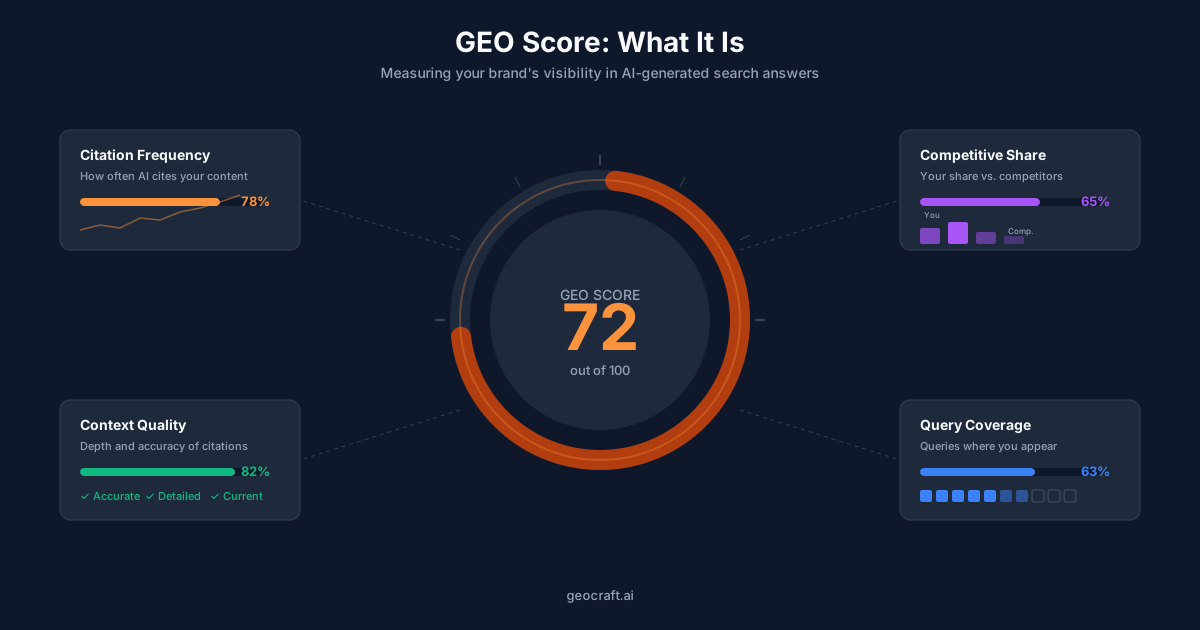
A GEO Score quantifies how visible your brand is in AI-generated answers. Think of it as the AI equivalent of your domain authority score — except instead of measuring how well you rank in Google, it measures how often AI engines cite your brand when answering relevant queries.
GEO Score ranges:
| Score Range | Rating | What It Means |
|---|---|---|
| 0-15 | Invisible | Your brand is not cited in AI answers for your target queries |
| 16-30 | Emerging | Occasional citations, mostly in one AI engine |
| 31-50 | Visible | Regular citations across multiple engines, competitive gaps remain |
| 51-70 | Strong | Cited in majority of target queries, competitive with market leaders |
| 71-85 | Dominant | Top-cited brand in your category across most queries and engines |
| 86-100 | Category leader | Consistently the first-cited brand across all engines |
Most B2B companies start with a GEO Score between 0 and 15. That's not because their content is bad — it's because their content isn't structured for AI extraction.
How GEO Score Is Calculated
GEO Score is a weighted composite of four underlying metrics:
1. Citation Frequency (40% weight)
The percentage of your target queries where your brand is cited in AI-generated answers. This is measured across all configured AI engines (ChatGPT, Perplexity, Google AI Overviews, Claude, Copilot).
Example: If you track 20 target queries and your brand is cited in 8 of them across at least one engine, your citation frequency is 40%.
2. Competitive Share (25% weight)
Your share of total citations relative to tracked competitors. If AI engines cite your brand 15 times and your top competitor 40 times across the same queries, your competitive share is 27%.
Why it matters: Citation frequency tells you your absolute visibility. Competitive share tells you your relative position. You might have a 40% citation rate — but if your top competitor has 80%, there's a clear gap to close.
3. Citation Context Quality (20% weight)
Not all citations are equal. GEOCraft analyzes how your brand is positioned in each AI response:
| Context Type | Quality Score | Example |
|---|---|---|
| Primary recommendation | 100 | "GEOCraft is the leading platform for..." |
| Named comparison | 80 | "Tools like GEOCraft and Semrush both offer..." |
| Listed mention | 50 | "Options include GEOCraft, Ahrefs, and Moz" |
| Passing reference | 20 | "...similar to what GEOCraft calls a GEO Score..." |
Higher-quality citations drive more buyer consideration. Being recommended is worth more than being mentioned.
4. Query Coverage (15% weight)
The breadth of your AI visibility across different query types. Coverage is measured across:
- Purchase-intent queries ("best X tool")
- Comparison queries ("X vs Y")
- Informational queries ("what is X")
- Problem-solution queries ("how to fix X")
Broad coverage means your brand appears across the entire buyer journey, not just one stage.
How to Benchmark Your GEO Score
Industry Benchmarks (B2B SaaS)
Based on GEOCraft data across 200+ B2B SaaS companies:
| Company Stage | Average GEO Score | Top Quartile |
|---|---|---|
| Startup (pre-Series A) | 5 | 18 |
| Growth (Series A-B) | 14 | 32 |
| Scale-up (Series C+) | 28 | 51 |
| Enterprise (public) | 41 | 68 |
Key insight: Company stage correlates with GEO Score primarily through content volume and domain authority. But the variance within each stage is enormous — well-optimized startups can outperform poorly-optimized enterprise brands.
How to Run Your Baseline
- Sign up for GEOCraft (free baseline scan available)
- Configure your target queries (start with 15-25)
- Add 2-3 competitor domains
- Run the baseline scan
- Review your GEO Score and the underlying metric breakdown
The baseline scan takes minutes and gives you the complete picture: your score, your competitors' scores, and the specific queries where you're winning or losing.
How to Improve Your GEO Score
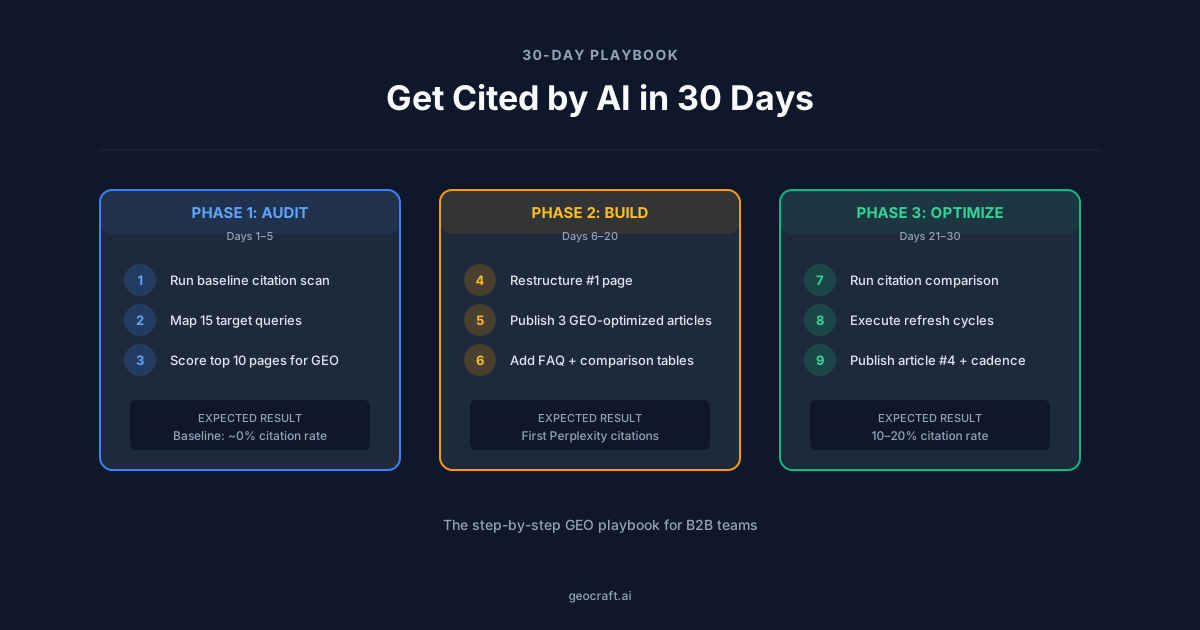
Quick Wins (1-2 Weeks)
Restructure existing content for AI extraction.
- Add answer-first openings to your top 10 pages
- Convert comparison prose into structured tables
- Add FAQ sections with concise, fact-dense answers
- Implement FAQPage schema markup
Expected impact: 5-15 point GEO Score improvement from structural optimization alone.
Medium-Term Gains (4-8 Weeks)
Fill your citation gaps with new content.
- Identify target queries where competitors are cited but you're not
- Publish 3-5 GEO-optimized articles per week targeting those gaps
- Focus on comparison content, data-driven research, and how-to guides
- Track citation rate changes weekly
Expected impact: 15-30 point GEO Score improvement with consistent content production.
Long-Term Compounding (3-6 Months)
Build a sustainable GEO content engine.
- Maintain weekly publishing cadence
- Refresh older content quarterly with updated data
- Expand target query list as you capture initial targets
- Build first-party data assets (benchmarks, research) for authoritative citations
Expected impact: 30-50+ point GEO Score improvement, with compounding returns as content library grows.
GEO Score vs. Other Metrics
| Metric | What It Measures | Limitation |
|---|---|---|
| Domain Authority (Moz) | Link-based authority for Google | No AI visibility data |
| Authority Score (Semrush) | Composite SEO authority | Limited AI engine coverage |
| Google Rankings | Position in traditional search | Doesn't predict AI citation |
| GEO Score (GEOCraft) | AI citation visibility across all engines | Requires target query configuration |
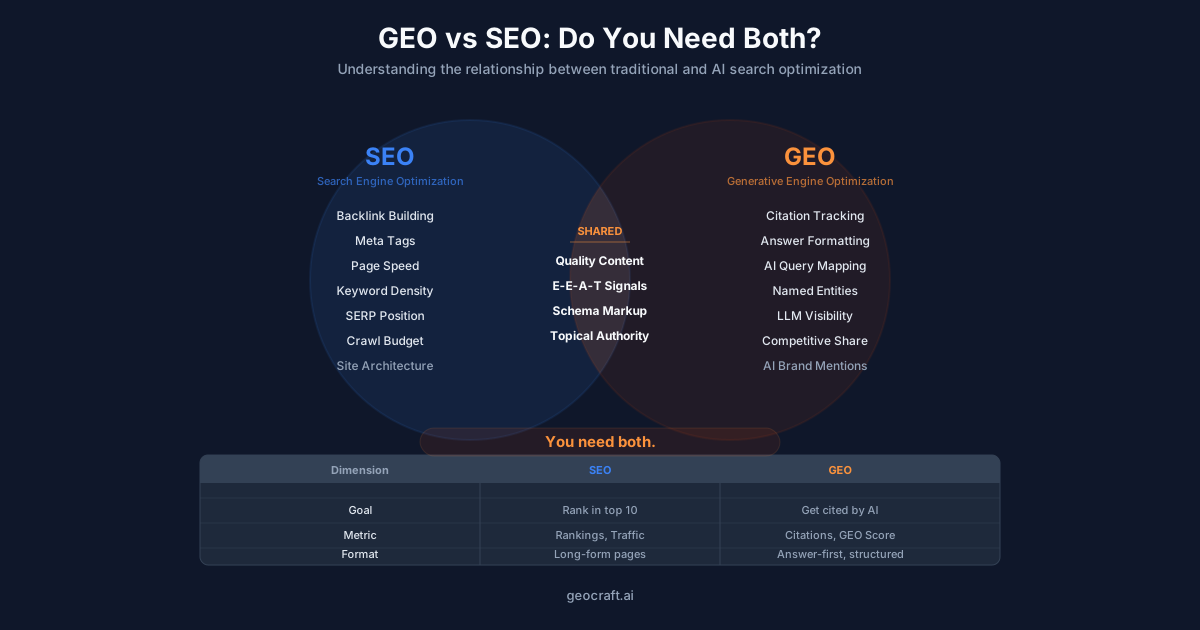
GEO Score complements rather than replaces traditional SEO metrics. A strong domain authority helps your GEO Score (especially for Google AI Overviews), but it's not sufficient on its own.
Tracking GEO Score Over Time
GEO Score is most valuable as a trend metric. A single score tells you where you are. The trend tells you whether your strategy is working.
Healthy GEO Score trajectory:
- Month 1: Baseline (typically 0-15 for new GEO programs)
- Month 2: 15-25 (initial content production kicks in)
- Month 3: 25-40 (citation momentum builds)
- Month 6: 40-60 (competitive position established)
Warning signs:
- Flat score for 4+ weeks → content isn't structured for extraction
- Score drops after a plateau → competitors are publishing more/better content
- High citation frequency but low context quality → content is mentioned but not recommended
GEOCraft tracks your GEO Score automatically and alerts you to significant changes. Start with a free baseline scan to get your current score.