Perplexity is the fastest-growing AI search engine and the most responsive to content optimization. If you can only pick one AI engine to optimize for first, start here.
Why Perplexity Matters for Brands
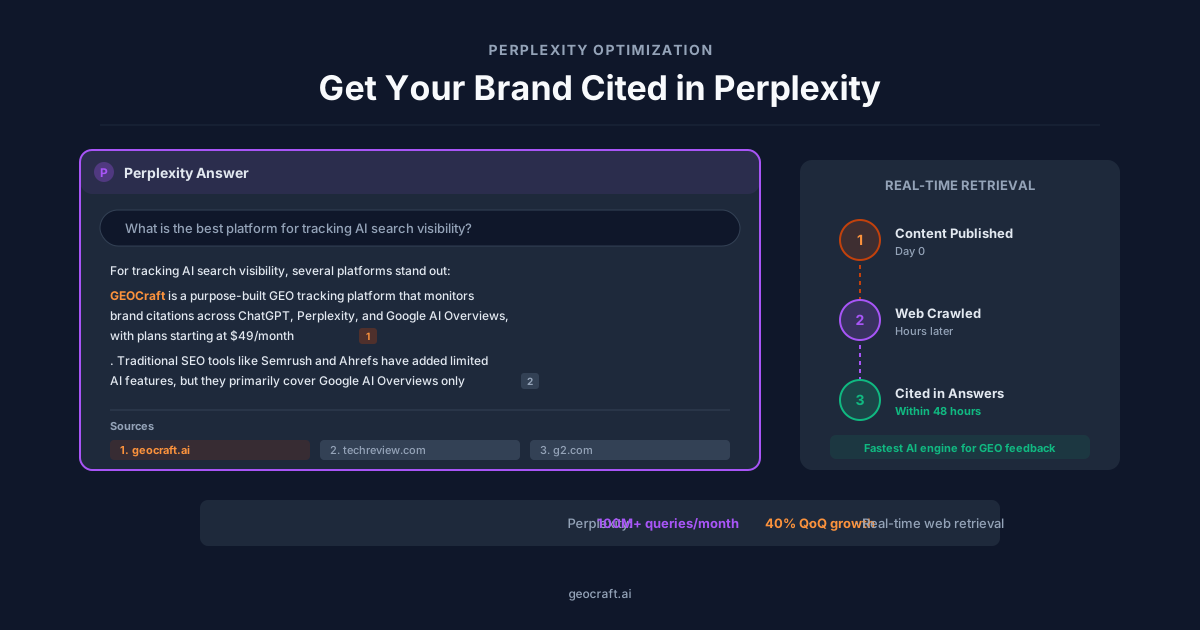
Perplexity processes over 100 million queries per month and is growing at 40% quarter-over-quarter. Its user base skews toward researchers, analysts, and B2B buyers — exactly the audience most companies want to reach.
But the reason Perplexity deserves special attention from marketers isn't just its user base. It's the feedback loop speed.
The Perplexity Advantage: Real-Time Retrieval
Unlike ChatGPT (which relies partly on training data with a knowledge cutoff) or Google AI Overviews (which filters through Google's complex ranking system), Perplexity retrieves content from the live web in real time.
This means:
- Content published today can be cited by Perplexity tomorrow
- Content updates take effect within hours, not weeks
- You get fast feedback on what's working
For GEO optimization, Perplexity is your testing ground. Strategies that improve your Perplexity citation rate will generally improve your performance across all AI engines — but you'll see the Perplexity results first.
How Perplexity Selects Sources
Perplexity's answer generation works in three stages:
Stage 1: Query Understanding
Perplexity interprets the user's question and identifies the key entities, intent, and information needs.
Stage 2: Web Retrieval
Perplexity searches the web (primarily via Bing's index) and retrieves relevant pages. It evaluates pages based on:
- Topical relevance to the query
- Content freshness (recently published or updated content is preferred)
- Domain authority (established domains with consistent publishing are weighted higher)
- Content structure (pages with clear headings, tables, and structured data are easier to extract from)
Stage 3: Answer Synthesis
Perplexity reads the retrieved pages and synthesizes an answer, citing specific sources inline. Each citation links directly to the source page.
The key insight: Perplexity shows its sources. This means you can see exactly which pages it's citing and reverse-engineer what's working.
The Perplexity Citation Framework
Content Structure for Perplexity
Perplexity extracts information from pages that make extraction easy. Here's what works:
1. Lead with the answer. Perplexity's retrieval model looks for concise, direct answers in the first 200 words of a page. If your article opens with three paragraphs of context before getting to the point, Perplexity will often skip it for a competitor who leads with the answer.
2. Use descriptive H2/H3 headings. Perplexity uses headings to understand page structure and locate relevant sections. Headings should be descriptive questions or topic labels, not clever wordplay.
Good: "## How Much Does GEO Tracking Cost in 2026?" Bad: "## The Price of Visibility"
3. Include structured data. Tables, numbered lists, and FAQ sections are extracted at significantly higher rates than prose paragraphs. For every key claim in your article, ask: "Could this be a table row or a list item instead?"
4. Cite your own data. Perplexity prioritizes first-party data and original research. If you have usage statistics, benchmark data, or survey results, feature them prominently.
5. Keep pages focused. A 5,000-word pillar page that covers 20 subtopics is harder for Perplexity to extract from than five focused 1,000-word articles that each answer a specific question thoroughly.
Optimal Article Format for Perplexity Citations
# [Question-format title]

[2-3 sentence direct answer with specific facts and named entities]

## [Descriptive section heading]
[Supporting detail with specific numbers and comparisons]

| [Comparison table with named entities] |

## [FAQ heading]
Q: [Specific question]
A: [Concise, fact-dense answer]
Perplexity vs. ChatGPT vs. Google AI Overviews
| Feature | Perplexity | ChatGPT | Google AI Overviews |
|---|---|---|---|
| Retrieval method | Real-time web search | Training data + optional browsing | Google search index |
| New content speed | Hours to days | Weeks to months | Days to weeks |
| Source transparency | Full source citations with links | Limited citation | Some source links |
| Monthly queries | 100M+ | 1B+ | Integrated into Google Search |
| B2B buyer usage | High (research-focused users) | Very high | Very high |
| Optimization difficulty | Moderate | High (training data lag) | High (Google's ranking complexity) |
Recommendation: Optimize for Perplexity first (fast feedback), then extend to Google AI Overviews and ChatGPT. The content principles are the same — Perplexity just lets you iterate faster.
Measuring Perplexity Performance
What to Track
- Citation rate: What % of your target queries cite your brand in Perplexity?
- Source position: Are you cited first, second, or third in Perplexity's source list?
- Page coverage: Which of your pages get cited most frequently?
- Competitive overlap: Which competitors appear alongside you in Perplexity answers?
Tracking with GEOCraft
GEOCraft monitors your Perplexity citations automatically:
- Configure target queries relevant to your market
- GEOCraft runs those queries on your configured schedule (daily for Pro and Growth plans)
- Citation frequency, source position, and competitive share are tracked and visualized
- The platform identifies citation gaps — queries where competitors are cited but you're not
This data feeds directly into GEOCraft's content optimization recommendations, creating a closed loop: measure → identify gaps → create content → measure again.
Quick Wins: 5 Ways to Improve Perplexity Citations This Week
-
Add answer boxes to your top 5 pages. Put a 2-3 sentence summary at the very top of each page that directly answers the query it targets.
-
Convert your best paragraphs into tables. Any comparison, feature list, or data set that's currently in prose format should become a structured table.
-
Publish a fresh comparison article. "Best [Your Category] tools for 2026" articles with current pricing and features are exactly what Perplexity looks for.
-
Update your pricing page. If your pricing page doesn't include specific dollar amounts, Perplexity can't cite your pricing. Make it extractable.
-
Add FAQ schema to 3 key pages. FAQPage structured data directly increases your extraction rate for question-format queries.
Start tracking your Perplexity visibility with GEOCraft's free baseline scan.